
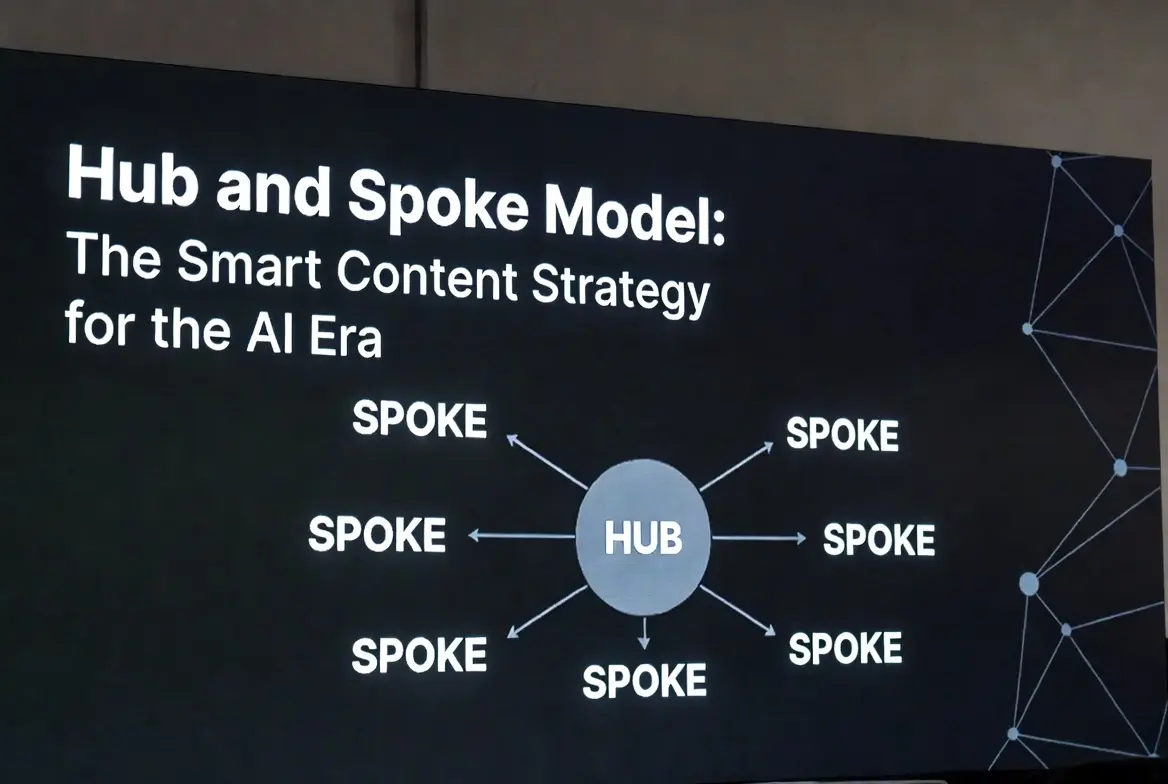
In the early days of blogging, getting traffic was a game of volume. You could publish 50 random articles on various keywords, and as long as you had decent backlinks, you would rank. In 2026, that strategy is not just ineffective—it’s a recipe for invisibility.
Google’s algorithms and modern Generative AI engines (like Perplexity and ChatGPT) have evolved. They no longer just look for matching keywords; they look for Entities and Topical Relationships. They want to know if a website is a “jack of all trades” or a “master of one.” This is where content structure becomes your greatest competitive advantage.
The Hub and Spoke model is the modern solution to the AI-driven shift in search. It is a structural framework that mirrors how human experts organize knowledge. At Agent Writing, we have used this exact model to scale sites to Mediavine requirements because it proves to search engines that we aren’t just writing for clicks—we are building a definitive resource. This article will show you exactly how to implement this system to ensure your traffic grows even as AI changes the rules of the game.
What Is the Hub and Spoke Model?
At its core, the Hub and Spoke model (often referred to as “Topic Clusters”) is a way of organizing your website’s content into a logical hierarchy. Instead of a flat list of blog posts, you create a network of information.
-
The Hub: This is your cornerstone content. It is a high-level, comprehensive overview of a broad topic. It isn’t meant to answer every specific question, but rather to introduce the reader to every “branch” of that topic.
-
The Spokes: These are the detailed subtopic pages. Each spoke dives deep into a specific question or problem mentioned on the hub page.
-
The “Glue”: The magic happens in the Internal Linking. The hub links to every spoke, and every spoke links back to the hub.
Think of it like a library. The “Hub” is the category sign on the shelf (e.g., “Photography”), and the “Spokes” are the individual books covering specialized areas (e.g., “Lighting Techniques,” “Choosing a Lens,” “Post-Processing”). By organizing your site this way, you make it incredibly easy for both humans and AI bots to navigate your knowledge.
Why the Hub and Spoke Model Works in the AI Era
As a publisher with experience on premium ad networks like Mediavine, I’ve seen firsthand how AI search engines treat unstructured data. If your information is scattered, AI models struggle to “verify” you as an authority. Here is why this model is mandatory in 2026:
Establishing Topical Authority
AI engines prioritize “Subject Matter Experts.” When you have a hub page surrounded by 20 detailed spokes, you are signaling Topical Authority. You aren’t just talking about a topic; you are exhausting it. Google rewards this by ranking your entire cluster higher because you’ve demonstrated a complete understanding of the niche.
Improved Internal Linking and Crawlability
In 2026, site speed and efficient crawling are vital. The Hub and Spoke model creates a clean “map” for search engine spiders. By interlinking spokes, you pass “Link Equity” (ranking power) throughout the entire cluster. If one spoke goes viral, the “authority” flows back to the hub and boosts every other spoke in that system.
Increasing Time on Site
When a reader lands on a spoke page and sees a link back to a comprehensive “Hub Guide,” they are more likely to stay on your site to learn more. For Mediavine publishers, more time on site and more pages per session translate directly into higher ad revenue.
Helping AI Tools Trust You as a Source
Generative AI tools look for “Context.” By grouping related content, you provide that context. This increases the likelihood that ChatGPT or Google’s AI Overviews will cite your site as a primary source because your site structure proves you have the “full picture.“
Hub vs Spoke: Clear Difference
Understanding the distinction between these two layers is the difference between a high-traffic site and a messy one.
What a Hub Page Looks Like
A hub page is your “pillar.” It should be long-form, evergreen, and highly structured. It uses broad “head terms” as its target keywords.
-
Goal: To provide a 10,000-foot view.
-
Length: Usually 2,000–3,000 words.
-
Key Feature: It contains “snippets” of information from every spoke, with “Read More” links to the detailed articles.
What a Spoke Page Looks Like
A spoke page is a “deep-dive.” It targets long-tail, specific queries.
-
Goal: To answer one specific question perfectly.
-
Length: Usually 1,000–1,500 words.
-
Key Feature: It includes highly specific data, personal experiences, and a clear link back to the parent hub.
Example Structure:
-
Hub: “The Ultimate Guide to Remote Team Management”
-
Spoke 1: “Best Time-Tracking Software for Remote Workers”
-
Spoke 2: “How to Conduct Remote Performance Reviews”
-
Spoke 3: “Remote Work Mental Health: A Manager’s Guide”
How to Choose a Good Hub Topic
Selecting the wrong hub is a common mistake. If your hub is too broad (e.g., “Business”), you can never exhaust it. If it’s too narrow (e.g., “Red Pens”), you run out of spokes.
Broad but Focused
The ideal hub topic is “medium-broad.” It should be a topic that requires at least 10–15 subtopics to be fully explained. As Al Jovayer Khandakar, I always look for topics where the “search intent” is educational. People should be coming to a hub to “learn,” not just to “buy.“
High Search Interest and Long-term Value
Your hub should be evergreen. Avoid seasonal trends for your primary hubs. You want to pick a topic that will be relevant in 2030. At Agent Writing, we analyze search data to ensure the hub has enough “gravity” to pull in traffic for years, while the spokes handle the specific, trending nuances of the topic.
How to Create Spoke Content Properly
Creating a spoke isn’t just about writing a short blog post. In the AI era, every spoke must provide Information Gain. This is where your personal experience and technical precision come into play.
A “Spoke” must focus on One Problem = One Solution. If you try to cover too much in a spoke, you dilute its ranking power. For example, if your spoke is about “Camera Settings for Night Photography,” don’t spend 500 words talking about camera brands. Focus entirely on the settings: ISO, Aperture, and Shutter Speed.
In 2026, searchers are impatient because they can get instant answers from AI. Your spoke must provide the “Human Edge.” This is where I add my personal testing data or specific client results from Agent Writing. Instead of just saying “use a high ISO,” I might say, “In my tests with the Sony A7IV for a night-sky project, I found that ISO 3200 was the ‘sweet spot’ before digital noise became unmanageable.”
This level of detail ensures that your spoke content targets Long-tail Keywords that AI summaries often miss. Long-tail keywords (like “best ISO for Milky Way photography in low light”) are the secret to Mediavine success because they attract a high-intent audience. These readers don’t just want an answer; they want an expert’s validation. By ensuring there is no overlap between spokes, you prevent “keyword cannibalization,” ensuring that each page on your site has a unique purpose and a clear path to ranking.
This is Part 2 of the guide. Here, we transition from the theory into the technical implementation—the “engine room” of the Hub and Spoke model. As a Top-Rated Plus Technical Writer, I have designed this section to be as precise as a technical manual, ensuring every internal link and structural choice serves a specific SEO purpose.
Internal Linking Strategy (The Most Important Part)
If the Hub and Spoke model is the body, the internal linking strategy is the nervous system. Without proper links, your content exists in isolation, and the AI bots will never see the “cluster” you’ve worked so hard to build. At Agent Writing, we follow a strict “Three-Way Link” protocol.
The Hub-to-Spoke Connection
The Hub page must act as a directory. Every single spoke in your cluster should be linked from the Hub. I prefer using descriptive anchor text (e.g., instead of “Click here,” use “See our full breakdown of Batting Basics”). This tells Google’s NLP (Natural Language Processing) exactly what the destination page is about.
The Spoke-to-Hub Connection
Every spoke article must have a link back to the Hub, ideally in the first or second paragraph. This establishes the hierarchy. It tells the search engine, “I am a detailed part of this bigger topic.” This is the most crucial step for building Topical Authority.
The Spoke-to-Spoke Connection
Spokes should link to each other when relevant. If your spoke on “Batting Basics” mentions “Throwing Mechanics,” you should link to that related spoke. This keeps the user (and the crawler) inside your ecosystem.
Expert Tip: Don’t just link randomly. Every link should serve the user’s intent. If a user is reading about a specific problem, the link should lead them to the next logical step in their journey.
Hub and Spoke vs. Traditional Blogging
Many bloggers are still stuck in the “Chronological” mindset. They publish whatever is interesting that week. In the AI era, that is a fatal mistake.