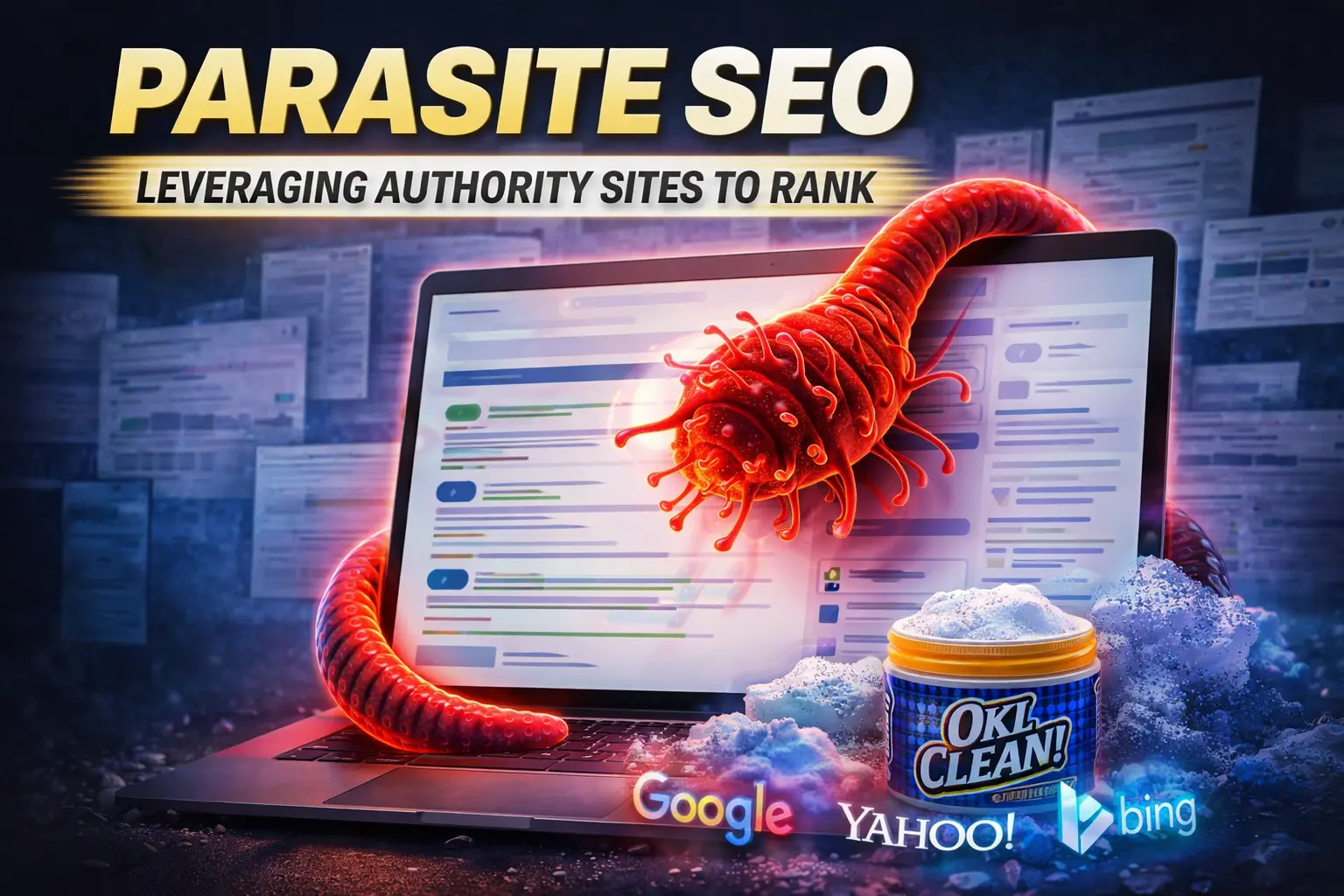
For years, the “Parasite SEO” playbook was the worst-kept secret in digital marketing: lease a subdomain from a high-authority news site, pump it full of affiliate coupons or “Best X” listicles, and watch the cash roll in. You didn’t need expertise; you just needed a host with a high Domain Authority (DA).
Those days are officially over.
Starting with the core updates of 2024 and culminating in the aggressive algorithmic enforcements of 2025 and 2026, Google has completely rewritten the rules of borrowed authority. Under their strict Site Reputation Abuse policy, Google’s SpamBrain AI now actively decouples and demotes third-party content that exists purely to manipulate search rankings.
At Agent Writing, I’ve watched countless niche site owners and massive publishers (even giants like Forbes and CNN) lose millions in traffic because they relied on lazy third-party hosting. I’ve had clients come to me in a panic after their “bulletproof” subdomain strategies were wiped out overnight. But here is the truth: Parasite SEO isn’t dead; it has just evolved.
If you pivot to “White-Hat Parasite SEO”—leveraging platforms built for user-generated content (UGC) with genuine E-E-A-T (Experience, Expertise, Authoritativeness, and Trustworthiness)—it remains one of the fastest ways to drive targeted, high-converting traffic.
In this guide, you will learn exactly how to navigate the 2026 landscape, including what Google specifically penalizes, how to choose the right host platforms, and the exact step-by-step workflow we use to rank safely.
What is Parasite SEO? (And Why Google Now Calls it “Site Reputation Abuse”)
At its core, Parasite SEO (often called Barnacle SEO) is the practice of publishing your content on an established, high-authority third-party website rather than your own. The goal is to bypass the months (or years) it takes to build domain trust and rank immediately for highly competitive keywords by “piggybacking” on the host site’s existing authority.
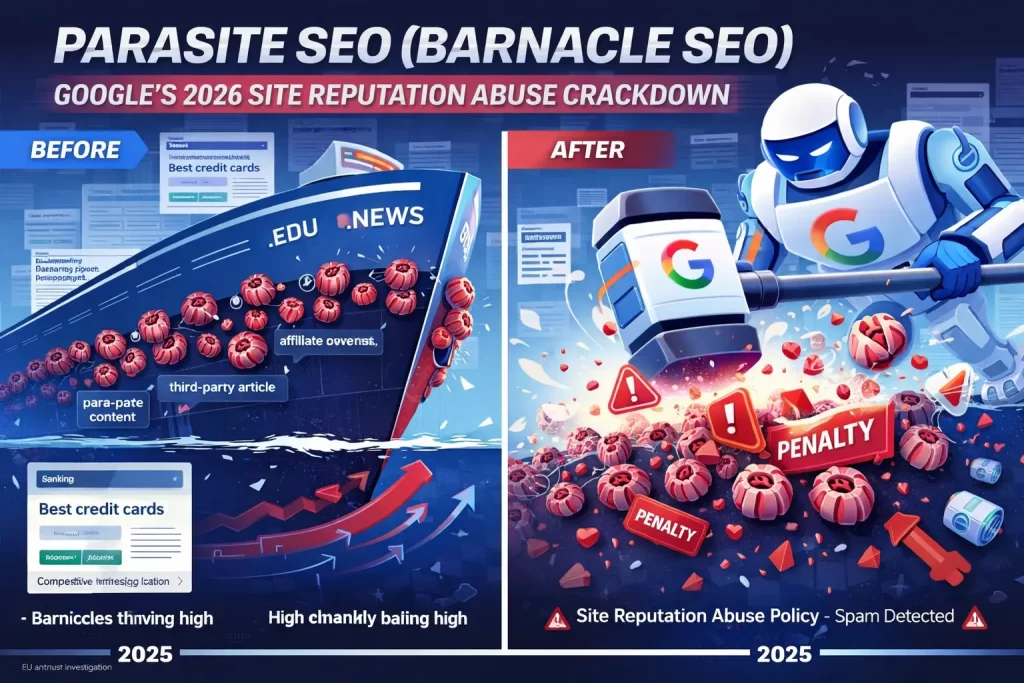
Historically, this meant paying an educational (.edu) or news site to host your article about “Best Credit Cards” or “Weight Loss Pills.”
The 2026 Reality: The Site Reputation Abuse Crackdown
Google recognised that this provided a terrible user experience. Why should a local newspaper rank #1 for global software reviews just because of its domain age?
To combat this, Google introduced the Site Reputation Abuse policy. Google explicitly defines this as: “Publishing third-party pages on a site in an attempt to abuse search rankings by taking advantage of the host site’s ranking signals.”
Here is the most critical update you need to understand for 2026: The “We Have Editors” defense no longer works. Previously, publishers tried to bypass the penalty by claiming they had “first-party oversight” over the sponsored content.
In late 2024 and into 2025, Google updated their documentation to clarify that no amount of first-party involvement or complex licensing agreements exempts a site from compliance. If the content’s primary purpose is to exploit ranking signals, it is spam.
(Note: This crackdown has been so severe that in late 2025, the European Union actually launched an antitrust investigation into Google, prompted by publishers complaining about lost revenue. That is how aggressively Google is enforcing this rule today.)
White-Hat vs. Black-Hat Parasite SEO in 2026
To survive in this ecosystem, you must understand the clear dividing line between what Google considers “Spam” and what it considers “Valuable Contribution.”
The Black-Hat Approach (What Gets You Penalized)
This is the “Churn and Burn” model. If you do this in 2026, Google’s algorithm will isolate that specific subfolder from the parent domain’s authority, rendering your content invisible.
- Topical Irrelevance: Publishing a review of a crypto exchange on a medical journal’s website.
- Leasing Subdomains: Paying for URLs like
coupons.localnews.comto host white-label affiliate feeds. - Zero E-E-A-T: Publishing AI-generated or templated reviews without any proof that the author actually tested the product.
- Hidden Links: Disguising affiliate reviews as objective editorial pages without clear “Sponsored” or “Affiliate” disclosures.
The White-Hat Approach (What Works Right Now)
White-hat Parasite SEO is essentially high-level Digital PR and Community SEO. It relies on publishing on platforms that are designed for third-party, user-generated content, where your topic perfectly matches the audience’s intent.
- Topical Alignment: A B2B SaaS founder publishing a deep-dive technical architecture guide on Medium or Dev.to.
- Adding the “Experience” Factor: Incorporating original data, custom graphics, and first-hand testing notes (the crucial “E” in E-E-A-T).
- Providing Value First: Answering a complex question thoroughly on Reddit or Quora, and only linking back to your site as a secondary resource for more depth.
- Native Platforms: Utilizing LinkedIn Articles or YouTube Video Descriptions to capture commercial-intent searches.
When we run campaigns at Agent Writing, we treat a White-Hat Parasite post with the exact same editorial rigor as a post on our own domain. If you wouldn’t proudly put your name and face on the article, it shouldn’t be published on a third-party site.
The Best “Safe” Platforms for Parasite SEO in 2026
If renting subdomains on news sites is dead, where do you publish? The answer lies in UGC (User-Generated Content) platforms. Google has explicitly tuned its algorithm to surface genuine human conversations and thought leadership. By publishing on these platforms, you align with Google’s goals rather than fighting them.
1. LinkedIn Articles & Newsletters (The B2B Goldmine)
LinkedIn is arguably the most powerful Parasite SEO platform in 2026, especially for B2B, SaaS, and high-ticket consulting.
Why Google Trusts It: LinkedIn requires verified human profiles. The platform has an incredibly high Domain Authority (DA), and Google indexes its articles rapidly.
The Play: Don’t just post a link to your blog. Write a comprehensive, 1,500-word native LinkedIn Article targeting a commercial keyword (e.g., “Best CRM Software for Healthcare 2026”). Because of LinkedIn’s domain strength, this article can often outrank your own website, while still funneling highly qualified leads directly to your services.
2. Reddit & Quora (The Community SEO Boom)
Since the Helpful Content Updates, Google has heavily favored Reddit and Quora in the “Discussions and Forums” SERP features.
The Trap: If you create a fresh Reddit account and immediately drop a link to your affiliate site, you will be shadowbanned within minutes by moderators.
The Play: Find highly specific, mid-tail keyword questions. Write a detailed, formatting-rich answer right there on the platform. Add value first. At the very end, include a soft call-to-action: “If you want to see the exact spreadsheets I used for this, I broke them down in my guide here [Link].”
3. Medium, Dev.to, & Hashnode (Niche Authority Hubs)
For technical niches, programming, and long-form essays, these platforms remain incredibly resilient.
Why Google Trusts Them: They have strict editorial guidelines and built-in community moderation.
The Play: Use Medium for broad thought leadership. Use Dev.to or Hashnode if you are in the software engineering or tech space. At Agent Writing, we often use Medium to syndicate content—publishing a unique, high-level summary of a technical topic that points back to the deeply technical, 4,000-word master guide on our client’s main domain.
4. YouTube (The Video Parasite Strategy)
People often forget that YouTube is a search engine with a massive DA.
The Play: You don’t always need a Hollywood-budget video. Create a highly optimized, simple tutorial video targeting a specific keyword. The “Parasite” element happens in the Description Box and the Pinned Comment. YouTube videos frequently rank on the first page of Google SERPs, and a well-placed link in a pinned comment can drive thousands of clicks a month.
The 5-Step Parasite SEO Strategy (The Agent Writing Playbook)
Now that you know where to post, here is how we execute these campaigns to ensure they rank and convert.
Step 1: Keyword Selection (The “Reverse SERP” Method)
The biggest mistake beginners make in Parasite SEO is targeting keywords that Google wants to answer with traditional editorial sites (like Forbes or Wirecutter).
In 2026, you must use the “Reverse SERP” Method:
- Search your target keyword. (e.g., “How to automate client onboarding workflow”)
- Scan the top 10 results.
- Look for UGC. If you see a Reddit thread, a Quora post, or a LinkedIn article currently ranking on page 1, that is a green light. It means Google’s algorithm has already decided that user-generated content satisfies the search intent for this specific query.
- Target Commercial-Investigation Keywords: Focus on keywords like “Best [X] for [Y]” or “How to solve [Specific Problem].” These have high buyer intent.
Step 2: Platform Matching (Aligning Intent with the Host)
You cannot put a square peg in a round hole. The platform must logically match the topic.
- If your keyword is: “Best Python Frameworks for AI 2026” $\rightarrow$ Platform: Dev.to or Medium.
- If your keyword is: “Is the Chase Sapphire Reserve worth it?” $\rightarrow$ Platform: Reddit (r/CreditCards).
- If your keyword is: “Enterprise SEO Agency Pricing” $\rightarrow$ Platform: LinkedIn Articles.
If you publish a highly technical coding tutorial on LinkedIn, or a B2B enterprise pricing guide on Reddit, the native audience will ignore it, engagement signals will drop, and Google will not rank the page. Context is everything.
Step 3: Creating “Un-Penalizable” Content (Injecting E-E-A-T)
If you publish a generic, AI-generated 500-word article on Medium or LinkedIn, Google won’t index it, let alone rank it. To survive the 2026 algorithms, your third-party content must actually be better than the first-party content currently ranking.
You must inject the first “E” in E-E-A-T: Experience.
- First-Hand Evidence: Do not just list the specs of a software tool; show a screenshot of you actually using its dashboard.
- Custom Assets: Create custom infographics or charts. Google’s Vision AI reads images perfectly now. If your Medium post has three original, data-driven charts, Google categorizes it as a “high-effort” resource.
- The “Agent Writing” Proof: I recently had a client at Agent Writing struggling to rank for a highly competitive SaaS keyword on their fresh domain. Instead of writing another generic blog post, we published a 2,000-word case study on LinkedIn detailing exactly how we used the software to increase client retention by 40%, complete with real data tables and timeline screenshots. That LinkedIn article hit #1 on Google in four days and stayed there for six months, driving hundreds of high-ticket leads back to the client’s site. That is the power of Experience.
Step 4: The Internal Linking Strategy (The “Safe Funnel”)
The entire point of Parasite SEO is to funnel authority and traffic back to your “Money Site” (your actual blog or landing page). But if you do this wrong, you trigger spam filters.
- The 90/10 Rule: 90% of the article should be pure value that keeps the user on the host platform. Only 10% should be promotional.
- Limit Your Outbound Links: Do not stuff the article with 15 keyword-rich anchor links pointing to your homepage. Use one or two highly relevant links pointing to a specific, deep-linked resource on your site.
- Natural Anchor Text: Avoid exact-match anchor text like “Click here for the best SEO agency.” Instead, use contextual anchors like: “As detailed in our recent analysis of 2026 core updates, the data shows…”
- Link to Authority Sources: To make your article look like a genuine editorial piece, link out to other high-trust sites (like a statistic from Statista or a quote from Google Search Central) in addition to your own site.
Step 5: Engagement & Signals (Feeding the Algorithm)
In 2026, Google relies heavily on user interaction signals (often gathered via Chrome data) to validate if a piece of UGC (User-Generated Content) is actually helpful or just spam. A Reddit post with zero upvotes or a Medium article with zero claps will quickly fall out of the SERPs.
- Drive Initial Traffic: The moment you publish your Parasite SEO piece, send it to your email newsletter or share it on your Twitter/X account.
- Spark the Comments: On platforms like LinkedIn or YouTube, the algorithm boosts content with active discussions. End your post with a controversial or highly specific question to prompt replies. When people reply, engage with them immediately.
- The “Velocity” Factor: Google looks at how quickly an article gains traction. An article that gets 50 genuine reads and 5 comments in the first 24 hours has a exponentially higher chance of ranking than one that sits dormant for a week.
Tracking Retention (The 2026 Challenge)
Getting to Page 1 with Parasite SEO is only half the battle; the real challenge in 2026 is staying there. Because UGC platforms are constantly updated with fresh content, Google tends to rotate these results more frequently.
- Monitor via Search Console: Set up a specific tracker (using tools like Ahrefs or Semrush) just for your Parasite URLs.
- The “Freshness” Update: If your LinkedIn article or Medium post starts dropping in rank after a few months, don’t abandon it. Go back into the platform, update the article with a new paragraph of “2026 Data,” change the publish date (if the platform allows), and reply to an old comment to trigger a fresh engagement signal. Google’s crawlers will notice the update and often bump the ranking back up.
Conclusion: The Bridge, Not the Castle
The “Wild West” era of buying cheap subdomains on news sites is dead, killed by Google’s Site Reputation Abuse policies. But strategic, value-driven White-Hat Parasite SEO is alive and thriving.
By leveraging high-authority platforms like LinkedIn, Reddit, Medium, and YouTube, and injecting them with genuine E-E-A-T and undeniable proof of experience, you can bypass the “sandbox” and capture highly competitive traffic in a matter of days.
However, remember the golden rule of digital marketing: Never build your entire house on rented land.
Parasite SEO is a bridge. It is a brilliant strategy to generate immediate cash flow, capture leads, and build brand awareness while you are doing the slow, steady work of building the Domain Authority of your own website. Master this balance, and you will dominate the 2026 search landscape.